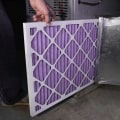
In our experience manufacturing air filters for over a decade and supplying more than two million households, the most common mistake we see isn't a failing HVAC system — it's an underperforming filter inside a system that's working exactly as designed. Upgrade the filter, and the air quality results can be dramatic without replacing a single piece of equipment.
This page will show you what a new AC unit actually does for indoor air quality, where filtration fits into the picture, and how to make the smartest decision for your home and your family's health.
TL;DR Quick Answers
Replacing Home AC Unit
Replacing a home AC unit improves cooling efficiency, airflow consistency, and humidity control. It does not filter allergens or dust. Here is what to know before you replace:
The filter inside your system — not the unit itself — is what captures dust, pollen, pet dander, and mold spores
A new system running a low-rated filter produces the same air quality as the system it replaced
Upgrading to a MERV 11 or MERV 13 filter is the highest-impact, lowest-cost air quality improvement available to most homeowners
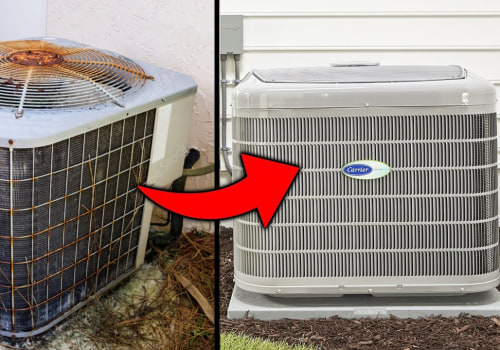
A new unit is worth replacing when your system is over 15 years old, humidity control is failing, airflow is uneven, or ductwork has significant leaks
A properly sized new system suppresses dust mite populations by maintaining indoor humidity below 50% — a real air quality benefit, but one that works alongside filtration, not instead of it
Bottom line: Upgrade the filter first. Replace the system when the system is the problem.
Top Takeaways
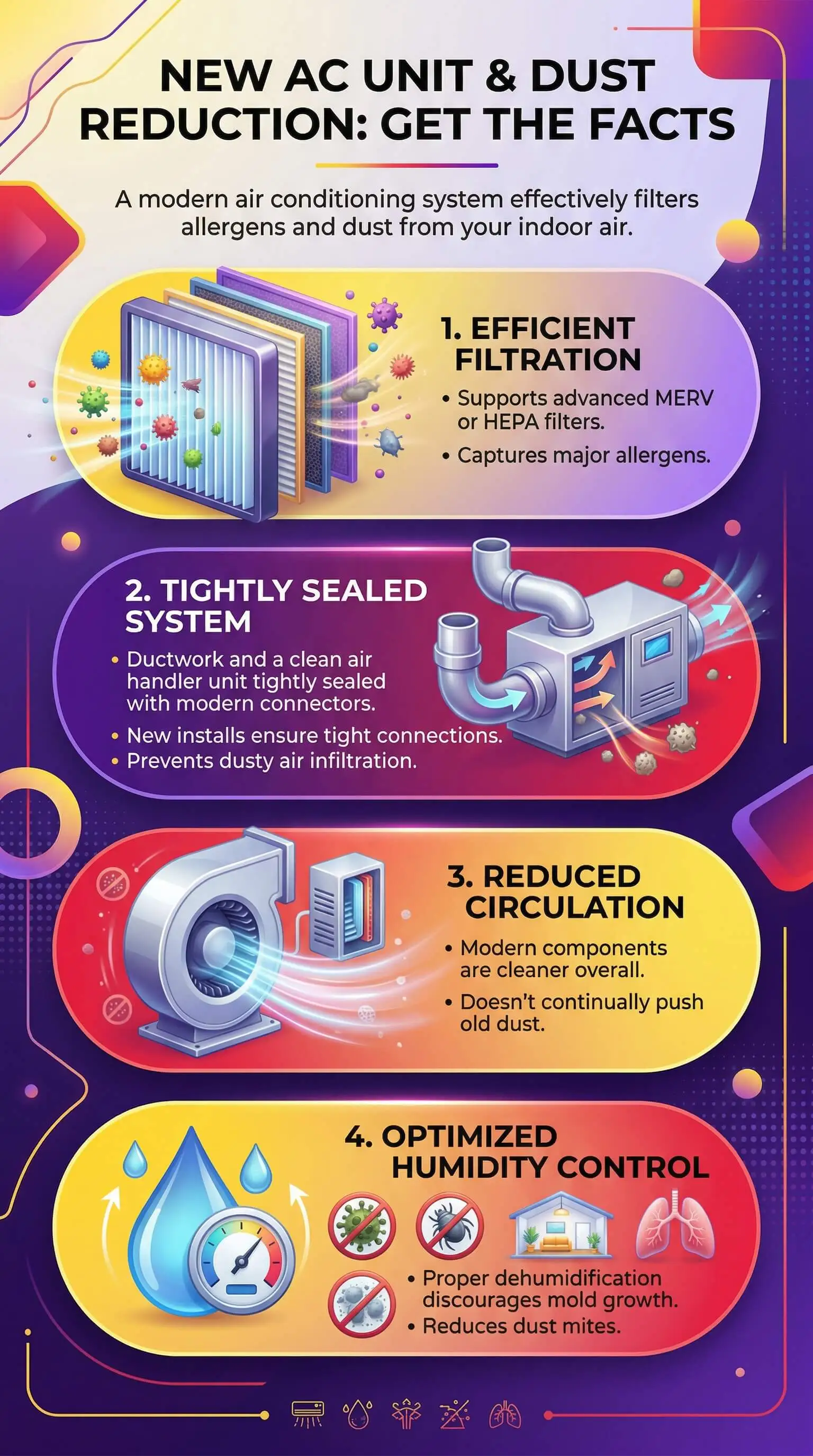
A new AC unit moves air. It does not clean it. The filter is the only mechanism that captures allergens and dust. New equipment without a filter upgrade produces no meaningful air quality improvement.
A MERV 11 or MERV 13 upgrade is the highest-impact, lowest-cost step most homeowners can take. In our experience, a single filter upgrade delivers more noticeable allergen relief than a full system replacement in the majority of homes we've worked with.
A new AC unit's biggest air quality contribution is humidity control — not filtration. A properly sized modern system can maintain indoor humidity below 50%. NIH research confirms that threshold reduces dust mite allergen levels more than 10 times. That matters — but it works alongside filtration, not instead of it.
The most common mistake we see: a new system running a builder-grade filter. No one has the filtration conversation on installation day. Symptoms persist. The fix is almost always a $30 filter change — not another equipment investment.
Your HVAC system is the infrastructure. Your filter is the intervention. Get both right — and your home will have genuinely cleaner air, not just newer equipment running through it.
What a New AC Unit Actually Does for Your Air
A new AC unit is engineered to do one thing well: condition your air. It cools it, dehumidifies it, and circulates it throughout your home more efficiently than an aging system can, which also plays a role in maximizing the lifespan of an AC system. What it is not designed to do is clean that air. There is no mechanism inside the AC unit itself that captures allergens, traps dust, or removes airborne particles. That function belongs entirely to your air filter.
This is one of the most important distinctions we see homeowners miss. After manufacturing filters for over a decade and working with more than two million households, we've consistently found that air conditioner filters play a central role in improving indoor air quality. A brand-new system paired with the right filter can help capture dust, pollen, pet dander, and mold spores throughout your home on every cycle.
How Allergens and Dust Actually Get Captured
Every time your HVAC system runs, it pulls air through a return vent and pushes it across your filter before redistributing it through your home. That filter is the only checkpoint between the airborne particles in your living space and the air your family breathes.
How much your filter captures depends on its MERV rating — Minimum Efficiency Reporting Value — a standardized scale that measures a filter's ability to trap particles of different sizes:
MERV 8 captures larger particles like dust, pollen, and lint — a solid baseline for most homes
MERV 11 adds capture of finer particles including mold spores, pet dander, and some bacteria
MERV 13 captures the smallest airborne particles, including fine dust, smoke, and virus-carrying droplets — the strongest residential option without restricting airflow
In our experience, households dealing with persistent allergy symptoms or visible dust buildup are almost always running a MERV 8 or lower. Stepping up to a MERV 11 or MERV 13 filter inside the same existing system frequently delivers more noticeable air quality improvement than a full equipment upgrade would.
Where a New AC Unit Does Make a Difference
A new system isn't irrelevant to air quality — but its contribution is indirect. Here's where a newer unit genuinely helps:
Improved airflow consistency. Aging systems develop pressure imbalances that cause some rooms to receive less conditioned air. Uneven airflow means uneven filtration — some areas of your home cycle through the filter less frequently, allowing particles to settle and accumulate. A properly sized new system distributes air more evenly, which means your filter works more uniformly across the whole home.
Tighter refrigerant and duct connections. Older systems often develop small leaks in ductwork that allow unconditioned, unfiltered air to enter the supply stream. New installations with properly sealed ducts eliminate that bypass, ensuring every cubic foot of air passes through the filter as intended.
Better humidity control. Modern AC units regulate humidity more precisely. High indoor humidity encourages mold growth and dust mite proliferation — two of the most common household allergen sources. Keeping relative humidity between 30% and 50% is one of the most effective allergen-suppression strategies available, and newer systems do this more reliably.
The Smarter First Step Before You Replace Your System
If allergen reduction is your primary goal, replacing your AC unit should not be the first move. In our experience working with homeowners across the country, the fastest and most cost-effective path to cleaner air follows this order:
Upgrade your filter to MERV 11 or MERV 13 and commit to changing it on schedule — every 60 to 90 days, or more frequently if you have pets or allergy sufferers in the home
Have your ductwork inspected for leaks, gaps, or buildup that could be reintroducing contaminants into your air supply
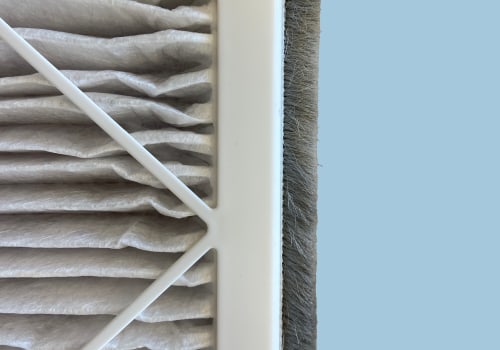
Schedule a professional HVAC tune-up to verify your system is moving the correct volume of air and that your filter slot is properly sealed with no bypass gaps
If those steps don't resolve your air quality concerns — or if your system is more than 15 years old, running inefficiently, or struggling to maintain temperature — then a top AC replacement becomes a much more justified investment, and one that will perform significantly better when paired with the right filter from the start.
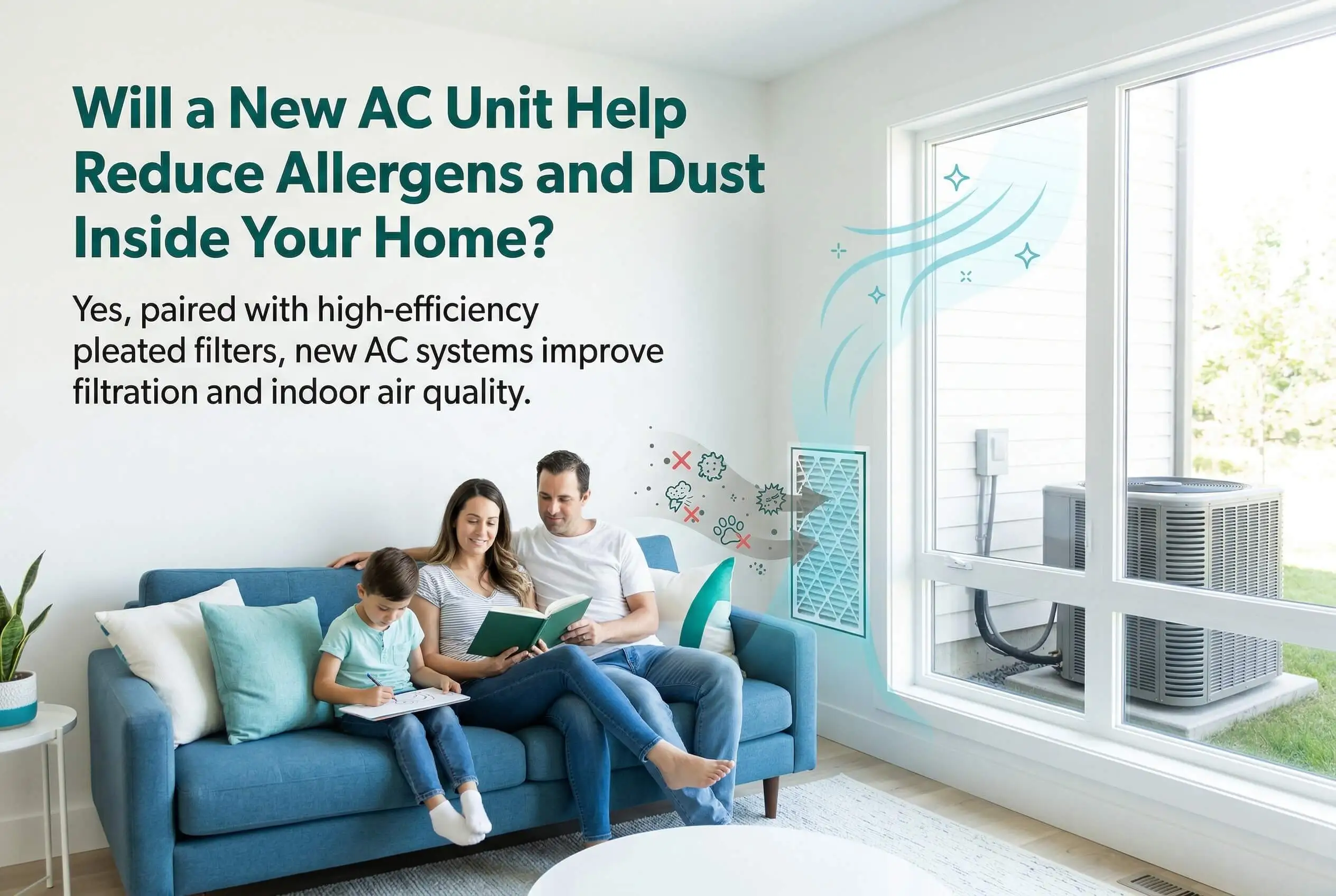
"Homeowners are often surprised when we tell them that the most impactful air quality upgrade they can make has nothing to do with their equipment. After manufacturing filters for over a decade and supplying more than two million households, we've seen this pattern more times than we can count — a family invests in a brand-new AC system and still can't understand why their allergies aren't improving. Nine times out of ten, the answer is the filter. The unit moves the air. The filter protects the family. Those are two different jobs, and only one of them requires a five-figure investment. Matching the right MERV rating to your household's specific needs — pets, allergies, dust sensitivity — is the decision that actually changes what your family breathes every day."
Essential Resources
After years of working in homes just like yours, we've learned that the homeowners who get the best results are the ones who go in informed. These resources come from federal health and energy agencies — no brand agendas, no sales pitches. Just reliable guidance that helps you make the right call for your family.
1. The EPA's Plain-English Overview of What's Actually in Your Indoor Air
Most people are surprised by what's floating through their home. The EPA's indoor air quality introduction identifies the most common airborne allergens found in residential HVAC systems and explains why filtration and ventilation matter more than the equipment alone. Start here if you're new to this conversation. https://www.epa.gov/indoor-air-quality-iaq/introduction-indoor-air-quality
2. The EPA's Practical Guide to Making Your Indoor Air Actually Better
Knowing there's a problem is one thing. Knowing what to do about it is another. This EPA resource covers what actually works — ventilation, source control, and air cleaning — and explains why treating them as a system, not separate fixes, is what gets results. https://www.epa.gov/indoor-air-quality-iaq/improving-indoor-air-quality
3. The EPA's Breakdown of Every Common Household Allergen and How It Travels Through Your HVAC System
Pet dander, dust mites, mold spores, pollen — they all behave differently and require different filtration strategies. This resource tells you exactly what you're dealing with before you make any decisions about your system or your filter. Don't guess. Know. https://www.epa.gov/indoor-air-quality-iaq/what-are-allergens-and-where-do-they-come
4. The EPA's Side-by-Side Comparison of Every Air Cleaning Technology Available to Homeowners
MERV-rated filters, HEPA filters, UV purification, electronic air cleaners — they're not interchangeable. The EPA breaks down what each technology captures, what it misses, and how it fits into a central HVAC system. Read this before spending money on an upgrade that may not address your specific problem. https://www.epa.gov/indoor-air-quality-iaq/guide-air-cleaners-home
5. Why Ventilation Is the Part of This Conversation Most Homeowners Miss Entirely
A tight, energy-efficient home holds allergens in. Filtration helps — but without fresh air exchange, you're recycling the same air over and over. The DOE's ventilation resource covers energy recovery and heat recovery ventilators and explains why ventilation strategy is far easier and less expensive to plan before installation than to add after. https://www.energy.gov/energysaver/ventilation
6. The Federal Standard That Separates a Good AC Installation From a Great One
Not all installations are equal. ENERGY STAR's HVAC Quality Installation benchmark outlines what a properly completed AC installation actually requires — system sizing, airflow verification, duct leakage testing, and refrigerant charging. If allergen reduction is part of your goal, this is the standard your contractor should be meeting. https://www.energystar.gov/saveathome/heating-cooling/hvac-quality-installation
7. What Federal Health Researchers Say About Moisture, Mold, and Your HVAC System
Humidity and mold are two of the most common allergen drivers in residential homes — and both are directly tied to how your HVAC system is designed and maintained. NIOSH's guidance on dampness and mold in buildings explains the connection clearly and is worth reading before any installation decision where moisture control is part of the picture. https://www.cdc.gov/niosh/topics/indoorenv/dampnessmold.html
These essential resources help homeowners understand indoor air quality, allergens, ventilation, moisture control, and installation standards so they can choose top air filters and make more informed HVAC decisions for healthier air at home.
Supporting Statistics
We hear it constantly from homeowners who've just installed a brand-new system and still can't shake their allergy symptoms: "We thought a new unit would fix it." The federal data explains exactly why it didn't.
The Air Inside Your Home Is Likely More Polluted Than the Air Outside
The EPA reports that Americans spend approximately 90% of their time indoors — where pollutant concentrations run 2 to 5 times higher than outdoor levels, and in some cases more than 100 times higher.
After more than a decade manufacturing filters, that statistic has never surprised us. What does surprise homeowners is this:
A new AC unit does nothing to change indoor pollutant concentrations
Without a filter rated to capture fine particles, you're circulating a more concentrated pollutant environment more efficiently
That's not an air quality upgrade — it's faster air movement through an unguarded checkpoint
Source: U.S. Environmental Protection Agency — Indoor Air Quality https://www.epa.gov/report-environment/indoor-air-quality
25 Million Americans Have Asthma — and the Triggers Are Already Inside the Home
CDC surveillance data confirms approximately 25 million Americans — 7.7% of the U.S. population — currently have asthma. Every major indoor trigger moves through residential HVAC systems on every cycle:
Dust mites
Mold spores
Pet dander
Pollen
Cockroach allergens
In our experience working with allergy and asthma households, a single filter upgrade — from MERV 8 to MERV 11 or MERV 13 — is frequently the first intervention that produces a noticeable reduction in symptoms. No equipment replacement required.
Source: Centers for Disease Control and Prevention — Asthma Surveillance in the United States https://www.cdc.gov/asthma/asthma-prevalence-us-2023-508.pdf
Humidity Control Can Reduce Dust Mite Allergen Levels by More Than 10 Times — and That's Where a New AC Unit Actually Earns Its Keep
NIH-indexed research tracking homes over 17 months found that maintaining indoor relative humidity below 51% reduced dust mite allergen levels more than 10 times lower than homes without humidity control.
This is the data point we return to most when homeowners ask whether a new AC unit is worth it for air quality. The honest answer:
A properly sized modern system often delivers better humidity regulation than an aging unit — and that directly suppresses dust mite populations
But humidity control and filtration are two separate mechanisms — one does not replace the other
A new system running a MERV 8 still passes pet dander, mold spores, and fine particulates into your living space
The filter has to do the filtering — regardless of how new the equipment is
Source: National Institutes of Health — PubMed, Reducing Relative Humidity to Control the House Dust Mite https://pubmed.ncbi.nlm.nih.gov/11149998/
Final Thoughts
After more than a decade manufacturing air filters and serving over two million households, we have a strong opinion on this topic — one that runs counter to what most homeowners expect to hear.
A new AC unit is a comfort and efficiency investment. It is not an air quality investment. That distinction costs homeowners real money every year.
Here's our honest take:
Replacing a low-rated filter with a MERV 11 or MERV 13 is the single most impactful air quality decision most households can make — it costs under $30 and takes under five minutes
A $10,000 system replacement running the same underperforming filter produces the same air quality result as the system it replaced
The homes with the most dramatic allergen reduction aren't always the ones with the newest equipment — they're the ones where someone made a deliberate, informed decision about filtration
New equipment is the right call when humidity control is failing, components are worn, or the system can no longer move adequate air volume
New equipment alone, without a filtration upgrade, is rarely the right answer for allergen reduction
We've watched this play out thousands of times.
A family invests in a full system replacement expecting cleaner air. Symptoms persist. They call us. We ask what filter is in the new unit.
The answer is almost always the same — a builder-grade MERV 4 or MERV 6 installed by the contractor on the day of the job, because no one had the conversation about filtration.
That conversation is the one that changes outcomes.
Remember:
Your HVAC system is the infrastructure
Your filter is the intervention
Understanding which one does which job is what separates a home with genuinely cleaner air from one that simply has newer equipment running through it
That's the perspective a decade of manufacturing gives you — and it's one we'll keep sharing, because better air for every household starts with getting that distinction right.
FAQ on Replacing Home AC Unit
Q: Will replacing my AC unit reduce allergens and dust in my home?
A: Not on its own. A new AC unit improves airflow, efficiency, and humidity control. It does not filter allergens or dust. That job belongs to the filter inside your system.
The pattern we see most often:
Family replaces their system expecting cleaner air
Symptoms persist
The culprit is a builder-grade MERV 4 or MERV 6 installed on installation day
The fix is a filter upgrade to MERV 11 or MERV 13 — not another equipment investment
Q: What MERV rating do I need to reduce allergens and dust in my home?
A: It depends on your household. Here is the framework we recommend:
MERV 8 — Captures dust, pollen, and lint. Best for homes without allergy or asthma concerns
MERV 11 — Adds capture of mold spores, pet dander, and finer particles. Best for homes with pets or mild allergy symptoms
MERV 13 — Captures fine dust, smoke, and virus-carrying droplets. Best for asthma households or severe allergy sufferers
For households managing asthma or persistent allergy symptoms, MERV 13 is the level we recommend most consistently.
Q: How does a new AC unit affect indoor humidity — and why does that matter for allergens?
A: A properly sized new AC unit regulates humidity more precisely than an aging system. That matters because humidity determines whether dust mites can survive in your home.
What the research confirms:
Dust mites thrive at 70 to 80% relative humidity
They cannot sustain populations below 50%
NIH-indexed research found that maintaining humidity below 51% reduces dust mite allergen levels more than 10 times
A modern, correctly sized system maintains that threshold more reliably than older equipment
This is where a new unit genuinely contributes to allergen reduction. It works through humidity management — not filtration. Both mechanisms matter. Neither replaces the other.
Q: Is it worth replacing my AC unit if my goal is better air quality?
A: Only if the system itself is the problem. A new unit is worth the investment when:
Your system is more than 15 years old and struggling to maintain temperature
Humidity control is failing — visible mold, persistent dampness, or high moisture readings
Airflow is uneven across rooms, meaning some areas bypass the filter
Ductwork leaks are allowing unfiltered air into your supply stream
If none of those conditions apply, a filter upgrade is the most cost-effective air quality improvement available. We have seen MERV 13 filter changes deliver more noticeable allergen relief than full system replacements in homes where the equipment was functioning correctly.
Q: How often should I change my AC filter to keep allergens and dust under control?
A: The right interval depends on what is in your home:
Every 90 days — Standard household, no pets, no allergy or asthma concerns
Every 60 days — One pet, or mild allergy symptoms present
Every 30 to 45 days — Multiple pets, severe allergies or asthma, or high-dust environments
One pattern we see consistently: homeowners who upgrade to MERV 13 and skip regular changes end up worse off than those running MERV 8 on schedule. A clogged high-MERV filter:
Restricts airflow
Reduces system efficiency
Allows particle bypass around the filter frame
The filter rating matters. The change schedule matters just as much.
Ready to Reduce Allergens and Dust in Your Home? Start With the Right Filter.
A new AC unit is a great start — but the filter inside it is what protects your family's air every day. Shop Filterbuy's MERV 11 and MERV 13 filters to find the right fit for your system and start breathing cleaner air today.