Making the invisible visible is what we do, so here's the part most people miss: you don't need a purifier, a smart gadget, or an expensive HVAC overhaul to fix this. You need a filter cut to the exact size of your return, with a MERV rating matched to a workday's load. The guide below covers how to measure, what to pick, and why the precise fit and performance of custom air filters can make a bigger difference than the brand printed on the frame.
TL;DR Quick Answers
custom air filters
Custom air filters are HVAC filters cut to the exact length, width, and depth of a return slot that doesn't match a standard size. They exist because a lot of American homes, especially older houses, additions, and media-cabinet returns, have slots that fall between the off-the-shelf dimensions stocked on a big-box shelf.
The fit matters more than most homeowners realize. After manufacturing filters for over a decade, we see the same issue on repeat: a near-fit filter lets air bypass the edges, pulls dust straight into the return duct, and sends it right back out through the supply vents. A custom cut seat flush against the gasket lip and forces every cubic foot of return air through the filter media.
Order a custom air filter when:
The return slot doesn't match a standard size like 14x25x1, 16x25x1, or 20x25x1.
The return sits in a 4-inch or 5-inch media cabinet with a non-standard opening.
The old filter shows bypass soot on the frame edges, a sign it's been out of position.
A room addition or garage conversion created a return on off-the-shelf filter fits.
How to order: measure the slot in inches (length x width x depth), round down, pick a MERV rating matched to the household (MERV 8 for basic dust and pollen, MERV 11 for pet dander and finer dust, MERV 13 for smoke and fine particulate if the HVAC blower supports it), and submit those exact dimensions to a direct-to-consumer manufacturer. Turnaround is typically one to two weeks.
Top Takeaways
The WFH room is the highest-occupancy room on weekdays. One person spending 40-plus hours a week in one space loads the HVAC filter faster than any other room in the home.
Standard filter sizes don't fit a lot of American homes. Older houses, additions, and media-cabinet returns frequently have non-standard slots, and bypassing air around a near-fit filter cancels most of the filtration value.
Custom-cut filters close the fit gap. Cut to the exact length, width, and depth of the return, they force return air through the media instead of around it.
MERV 11 is our most common home-office recommendation. MERV 13 is better for wildfire smoke or respiratory conditions, but check the HVAC blower first.
Measure the slot, not the old filter. Nominal sizes printed on the filter frame can be off by up to half an inch from the real slot dimensions.
Why a Home Office Breathes Differently
A guest bedroom used twice a year and a home office used forty hours a week do not put the same load on an HVAC system. Time in the room changes everything downstream of the return grille. One person sitting, shifting, printing, and exhaling in the same eight-by-ten space loads the filter in a matter of days, not months. That's why the air filter serving a full-time home office fills up faster than any other in the house.
What builds up when one room carries the whole workday:
Dust that gets kicked back into the air every time the chair moves or the printer cycles.
Pet dander, because the dog or cat almost always sits with the remote worker, not in an empty living room.
Toner particulate and heat off-gassing from laser printers and warm electronics.
Chemical off-gassing from new desks, acoustic panels, and foam mats picked up during the remote-work reset.
Carbon dioxide building up behind a closed door. On its own it won't hurt anyone, but it's a clear signal that fresh air isn't exchanging the way it should.
The HVAC system reads all of it as extra work, which is why pleated furnace filters play such an important role. The filter loads faster, the blower pulls harder, and anything the filter fails to catch recirculates right back into the breathing zone above the keyboard.
What Custom Air Filters Solve That Standard Sizes Cannot
Standard filter sizes exist for the convenience of big-box retail shelves, not for the realities of American housing stock. Older homes, additions, and home offices built into former media cabinets almost never have return slots that match a 14x25 or 16x25 box on a hardware store wall. The homeowner measures the slot, walks in, and leaves with the nearest size that fits.
That gap between “nearest fit” and “actual fit” is the whole problem. Air takes the path of least resistance, and a quarter-inch gap around the filter edge is exactly that path. The air bypasses the filter media, pulls dust straight into the return duct, and redelivers it through every supply vent in the house, including the one feeding the office. That's where custom air filters come in. Cut to the exact length, width, and depth of the return, they seat flush against the gasket lip and force every cubic foot of return air through the filter media instead of around it.
Custom sizing is the right call when:
The return is in an older home built before standard filter sizing was common.
The return sits in a 4-inch or 5-inch media cabinet with a non-standard slot.
A room addition or garage conversion created a return that doesn't match any off-the-shelf size.
The old filter has visible bypass soot on the frame edges, which tells you it's been out of position for a while.
How to Measure Your Return for a Custom Filter
A custom order succeeds or fails on one good measurement. Six minutes with a tape measure saves two trips to the hardware store and a filter that never fits. Here's the order we walk customers through:
Turn the HVAC off at the thermostat. The blower can't be pulling air through the slot while the filter is out.
Pull the old filter and ignore the printed nominal size on the frame. Nominal and actual are frequently off by up to half an inch, and we've shipped enough replacements to know that's where most custom orders go wrong.
Measure the actual filter slot in inches: length, width, and depth. A standard thin filter is one inch deep; a media cabinet is usually four or five.
Round down, not up. A filter an eighth of an inch too large won't seat. A filter an eighth of an inch small still seals against the gasket lip.
Note the airflow direction arrow on the old filter so the replacement goes in facing the same way.
Photograph the slot with a ruler in frame. It helps when placing a phone order or filling in a custom order form online.
Picking a MERV Rating for a Work-From-Home Room
MERV is the scale the industry uses to tell you what a filter can actually capture. The acronym stands for Minimum Efficiency Reporting Value. For home offices, three tiers cover almost every situation.
MERV 8
Catches larger dust, lint, and pollen. A reasonable floor for a healthy adult working in a pet-free room with no allergy concerns.
MERV 11
Catches pet dander, finer dust, and mold spores. This is the sweet spot we recommend most often for home offices, especially rooms shared with a dog or cat.
MERV 13
Catches smoke, bacteria, and fine particulates. The right choice during wildfire season or for a remote worker with asthma, as long as the HVAC blower can handle the pressure drop. Call an HVAC technician before jumping to MERV 13 on an older system.
When it comes to air filters for home, change the filter every 30 days during heavy WFH occupancy and every 60 days for part-time use. A pet in the office and an allergy-prone occupant shortens that interval, never lengthens it.
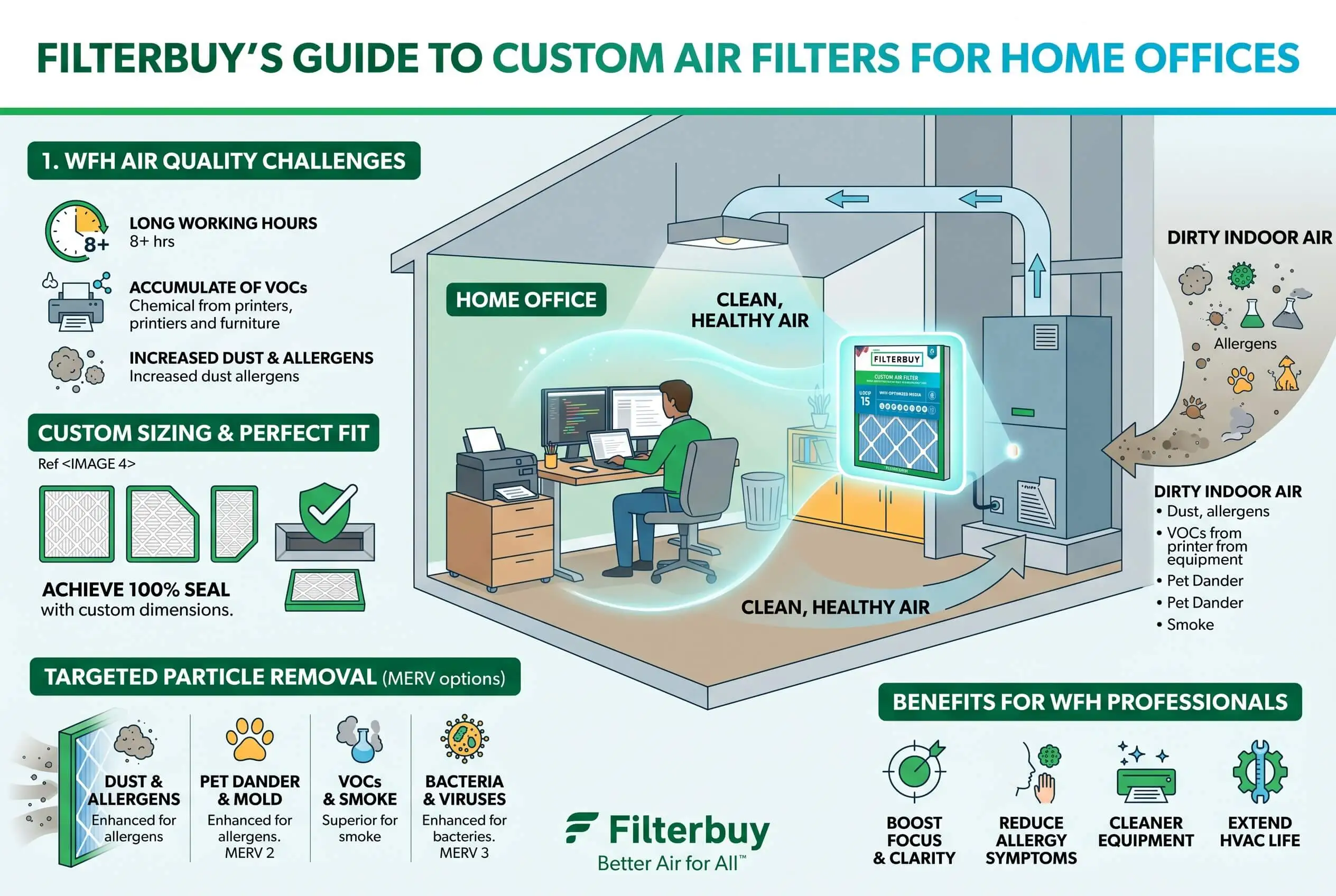
“After manufacturing filters for over a decade and shipping to more than two million households, we see the same pattern on almost every home-office call. The return is an odd size, the homeowner buys the nearest standard fit, and fine dust settles right back onto the desk inside a week. A custom cut closes that gap. For most WFH rooms, the right MERV rating matters more than the brand printed on the frame. The filter that fits is the filter that works.”
7 Essential Resources
Every resource below is a primary federal or standards-body source. These are the references we point customers to when a claim about filtration, ventilation, or indoor air quality needs to be checked against something more solid than a blog post.
1. The EPA Homeowner's Guide to Indoor Air Quality
A plain-language walkthrough from the federal agency that sets U.S. indoor air quality guidance. Read this before spending a dollar on an upgraded filter. It lays out what filtration can and cannot do, and where source control and ventilation do more of the work.
Source: EPA, The Inside Story: A Guide to Indoor Air Quality
2. EPA's Guide to Air Cleaners in the Home
The EPA's working reference on HVAC filters, portable air cleaners, MERV ratings, and how each one fits into a real household. This is also where the federal recommendation to use MERV 13 “or as high as the system will accommodate” for particulate removal originates.
Source: EPA, Guide to Air Cleaners in the Home
3. EPA Explainer on MERV Ratings
A short, direct walkthrough of what the MERV scale measures and why a higher number isn't automatically the right answer for every HVAC system. Read this one before ordering a custom filter at MERV 13.
Source: EPA, What is a MERV Rating?
4. EPA Guidance on HVAC Filters for Virus Protection
Federal guidance aimed at homeowners choosing a filter with respiratory-virus transmission in mind. Confirms the MERV 13 threshold and flags the need to check HVAC compatibility before upgrading.
Source: EPA, HVAC Filters to Protect Your Family
5. CDC and NIOSH Guidance on Ventilation and Respiratory Viruses
The federal occupational-health read on why ventilation and filtration belong in the same sentence. Relevant for WFH households that still host meetings, co-workers, or kids bringing classroom respiratory illness home.
Source: CDC/NIOSH, Ventilation and Respiratory Viruses
6. NIOSH Building Air Quality Reference
The federal catalog of indoor environmental quality research, including the full Building Air Quality reference that EPA and NIOSH co-authored. A WFH home is, in NIOSH terms, a non-industrial indoor work setting, and the guidance translates directly.
Source: CDC/NIOSH, Building Air Quality Guide
7. OSHA Building Operations and Indoor Air Quality
The federal workplace-safety perspective, which treats HVAC maintenance, filter replacement, and ventilation as the three pillars of acceptable indoor air. Home offices aren't under OSHA jurisdiction, but the engineering logic is identical.
Source: OSHA, Indoor Air Quality and Building Operations
Supporting Statistics
The following three numbers come straight from federal sources. Each links to the original page so you can check the research yourself.
1. Indoor air can be 2 to 5 times more polluted than outdoor air
The EPA's Total Exposure Assessment Methodology studies, the foundational federal research on indoor air, found that levels of about a dozen common organic pollutants ran 2 to 5 times higher inside homes than outside. The finding was held in rural areas and heavy industrial cities alike. For a remote worker spending eight or nine hours a day in one room, that concentration difference compounds with every hour. The filter on the HVAC return is the most practical line of defense.
Source: EPA, Introduction to Indoor Air Quality
2. Americans spend roughly 90 percent of their time indoors
The EPA's Report on the Environment puts the average American's indoor time at about 90 percent. For a full-time remote worker, the number skews higher. When more than nine-tenths of a day's breathing happens inside a single structure, the filter rating and fit on the HVAC return stops being a minor HVAC choice and starts being a household health choice.
Source: EPA, Indoor Air Quality Report on the Environment
3. 33 percent of employed Americans worked from home on days they worked in 2024
The Bureau of Labor Statistics' 2024 American Time Use Survey found that about a third of employed people spent time working at home on days they worked, up from the pre-pandemic 2019 baseline of 24 percent. Among workers with a bachelor's degree or higher, the rate reached 50 percent. The practical takeaway: the home office is no longer a rare use case. It's a primary indoor environment for tens of millions of households, highlighting the importance of proper maintenance and why the filter serving it should be specced accordingly.
Source: U.S. Bureau of Labor Statistics, American Time Use Survey 2024 Results
Final Thoughts and Opinion
Here's the uncomfortable part of the average work-from-home air setup: the room taking the most punishment from daily occupancy is almost always served by the cheapest filter in the house, installed in a slot it doesn't quite fit, and replaced on whatever schedule the homeowner happens to remember. None of that is malicious or lazy. It's what happens when a room's job in the house changes faster than its HVAC setup catches up.
Custom filters aren't an enthusiast upgrade. They're the correct answer for any home where the HVAC return isn't a standard size, which describes a much bigger share of American houses than the big-box filter wall implies. Pairing the right fit with the right MERV rating for the workday is the quietest, least glamorous, and most effective indoor-air-quality improvement a remote worker can make. No gadgets. No monthly app. No purifier fan running in the corner. Just a filter that actually seals, moves the right amount of air, and stops the right particles.
You're already the one in your household paying attention to this stuff. The piece that's usually missing is the information: that return sizes vary, that custom cuts exist, and that the MERV number matters more than the brand on the frame. Measure the slot, order to fit, and the dustiest room in the house stops being the one with the laptop in it.
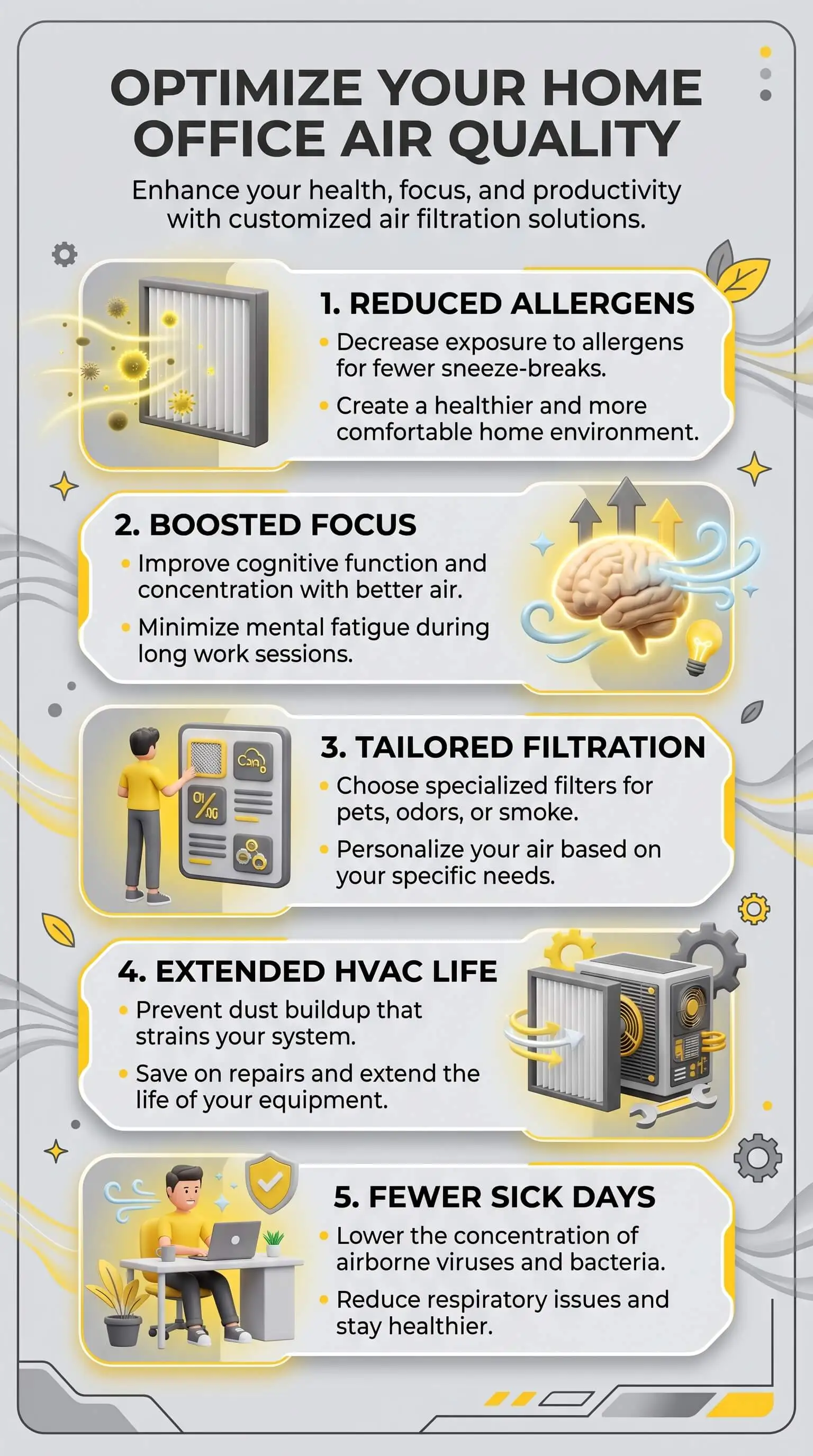
Frequently Asked Questions
Q: Are custom air filters worth it for a home office?
A: For a full-time remote worker whose HVAC return is a non-standard size, yes. A custom cut removes the bypass gap around a near-fit standard filter, so the particulate pulled into the return actually gets captured instead of routed straight back through the supply vents.
Q: What size air filter do I need for a home office?
A: The dimensions of the return slot, not the square footage of the office, determine the filter size. Measure length, width, and depth in inches. If the measurements don't line up with a standard size like 14x25x1, 16x25x1, or 20x25x1, a custom cut is the correct choice.
Q: What MERV rating is best for working from home?
A: MERV 11 is our most common answer for home offices with pets or mild allergies. MERV 13 handles smoke and fine particulate better and is the right call during wildfire season, as long as the HVAC blower is rated for the higher static pressure. A quick technician check is worth it before jumping two tiers up.
Q: How often should I change my home-office air filter?
A: Every 30 days during full-time WFH occupancy if there are pets or allergies in the house. Every 60 days for a single occupant with no pets. A two-week visual check is a useful habit during heavy-use months.
Q: Can I order custom air filters online?
A: Yes. Most direct-to-consumer filter manufacturers accept custom orders entered by length, width, and depth in inches. Turnaround runs about one to two weeks from order to delivery, and most operations match the MERV rating to the exact custom size on the same order.
Call to Action
Measure the return slot this weekend. Write down length, width, and depth in inches. Pick a MERV rating that fits the occupancy, whether that's MERV 11 for a standard home office or MERV 13 if the system supports it. Order a custom-cut filter to those exact dimensions and set a 30-day change reminder tied to your work calendar. A filter that fits the way it should is the quietest upgrade a home office ever gets, and it pays back every hour the laptop is open.